
16mm cine film digitisation UK cost: when a 5-minute reel costs more than your projector and why
 Maria C
16mm cine film digitisation in the UK costs between £13.49 and £29.69 per reel at our specialist lab — the price varies by reel size, not by “quality tier”. A 50-foot 3-inch reel (about 1.4 minutes of running time at 24 fps) is £13.49. A 200-foot 5-inch reel (5.6 minutes) is £22.49. A 400-foot 7-inch reel (11.1 minutes) is £29.69. Volume and early-bird discounts stack to drop the 7-inch reel to £19.79 net. Every reel runs through the same modified Bell & Howell scanner, the same wet gate fluid bath, the same 14-bit linear capture, the same DaVinci Resolve grade. There is no £15 path that produces the same file as the £30 path — the cheap end of the UK SERP for this query is wall-projection telecine, which is a different product, and the comparisons below show you why.
TL;DR: 16mm cine film digitisation in the UK costs £13.49 to £29.69 per reel at our specialist lab in May 2026, priced by reel size, not by quality tier — about £2.68 per minute of running time on a 7-inch 400 ft reel, £1.78 per minute with volume and early-bird stacked.
Why 16mm costs what it costs (and why the £15 quotes are not the same product)
The UK SERP for “16mm cine film digitisation cost” is dominated by price-list pages with no methodology. Digital Converters ranks first; their page lists a unit price and a buy-now button. Cine Conversions, DSVP and MEDIAFIX UK sit alongside in the top five. None explains what the £14, £19, £25 or £30 actually buys. None shows the difference between a wall-projection capture and a frame-by-frame scan. Both methods come back as a digital file; only one comes back recognisable.
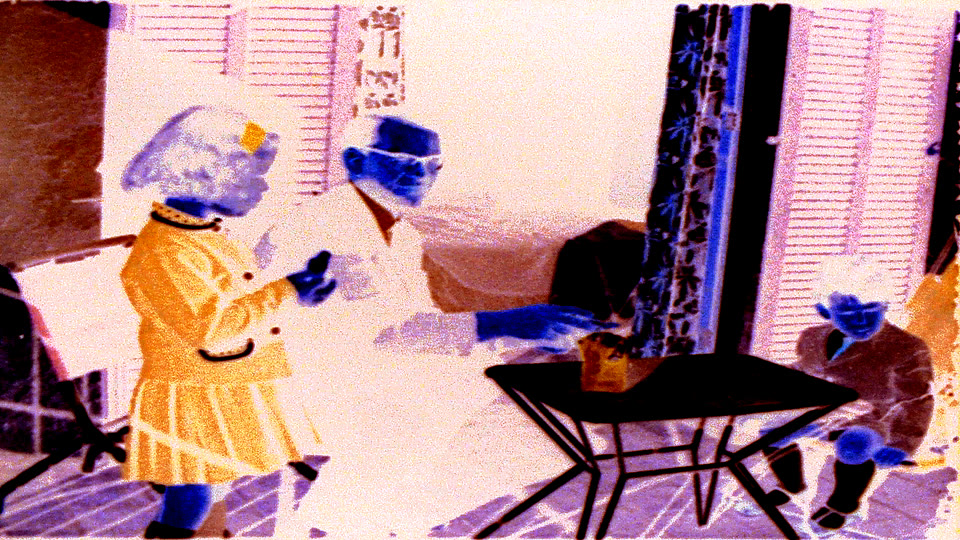
The slider below is from a 1971 Kodachrome wedding reel that arrived at our specialist lab last March. The reel is the same on both sides. The capture method is what changes. On the left, a competitor’s low-end “telecine” offering — a Bell & Howell projector throwing the image onto a small white wall, with a phone camera filming the screen. On the right, our modified Bell & Howell scanner running the same reel at one frame per capture, through a wet gate, into a 14-bit sensor. Drag the handle and look at the right-hand bride’s face.
A still slider can’t show the motion artefacts that make wall-projection capture so much worse than a frame-by-frame scan. The video pair below is the same 8-second clip from the same reel, running on both methods. Watch the corners — the projector vignette and lamp-flicker are constant; the scan version has neither. Watch the registration — the projector pull-down moves the frame slightly with every cycle, which is what produces the gentle vertical bounce we call “gate weave”. The scanner doesn’t have that.
The optical illusion of “cheaper price = same file” is what makes the £15 quote so persistent in this niche. It’s real: you can pay £15 for a 16mm reel and a digital file will arrive in the post. The file just won’t resemble what was on the celluloid. For a wedding reel that you intend to play once at a fortieth anniversary, the wall-projection method might be enough; for an inheritance reel that’s your only photographic record of a deceased relative, it isn’t.
What the price actually buys, by reel size
16mm runs at 24 frames per second when sound is involved (silent 16mm is usually 18 fps and gives 33% more running time per reel — most family 16mm is silent). At 24 fps a 50-foot 3-inch reel is 1.4 minutes; a 200-foot 5-inch reel is 5.6 minutes; a 400-foot 7-inch reel is 11.1 minutes. Our prices are flat per reel, not per minute, which means the cost per minute falls steeply as the reel gets bigger. A 7-inch reel is roughly five times cheaper per minute than a 3-inch reel:
Two numbers worth remembering: £2.68 per minute is what 16mm digitisation costs you at base price on a typical 7-inch reel; £1.78 per minute is what it costs once you stack the 21-day Early Bird return discount with the volume tier (40+ reels). For comparison, shooting and developing new 16mm at Cinelab London in March 2026 was around £65 per minute (100 ft of stock plus development plus scan). Digitisation is two orders of magnitude cheaper than the format costs to produce in the first place. That’s the right anchor for “is this expensive”.
What the £29.69 actually pays for, stage by stage
The line item on the invoice is one number. The lab pipeline behind it is four stages, each named, each measurable in operator-minutes. None of the cheap-quote competitors publishes this breakdown — that’s the vacuum this page is here to fill.



Wet gate is the single line item that most distinguishes a competent 16mm lab from a £15 telecine offering. The fluid bath dates to motion-picture restoration in the 1990s and works by optical refraction — the surface scratch is filled with a fluid that has the same refractive index as the film base, so the scratch literally vanishes from the captured image. It cannot be replicated in software. Software scratch removal paints over scratches by guessing what should be underneath; wet gate scans what was actually there.
The named lab equipment that does the work
If a specialist lab quotes you a 16mm price without naming the scanner, the gate, and the bit depth, you’re buying a price, not a process. We name ours:
Modified Bell & Howell 16mm scanner
Frame-by-frame transport, no projector lamp on the print
Original Bell & Howell deck 1950s; lab-rebuilt for sprocketless capture
- Handles 50ft, 100ft, 200ft, 400ft, 800ft and 1200ft reels
- Pin-registration kept; sprocket holes used only as positional reference
- No heat on the print — eliminates the most common projector damage cause
Wet gate fluid bath
Optical scratch suppression at scan time
Technique used in motion-picture restoration since the 1990s
- Refractive fluid fills surface scratches as the frame passes
- Scratches optically vanish — never painted out in software
- Critical for inherited 16mm prints worn by decades of projection
14-bit linear capture
Tonal headroom for the colour grade
Live in our pipeline since 2024
- 16,384 tonal steps per channel (vs 256 in 8-bit consumer telecine)
- Holds shadow detail in dark interiors and sun-flare in honeymoon footage
- Survives the colour grade without banding
DaVinci Resolve
Colour grade, stabilisation, conform
Industry-standard grading suite since 2014
- Restores Kodachrome, Ektachrome and reversal stocks to neutral
- Stabilises projector wobble frame-by-frame
- Delivers 4K ProRes 422 HQ master plus Full HD H.264
Optical and magnetic sound capture
Audio preservation for sound 16mm
16mm sound dates to RCA Photophone, 1932
- Optical track read by photo-cell at scan time, sample-locked to picture
- Magnetic stripe (post-1958) read by a separate playback head
- Cleaned in iZotope RX — never auto-loudness-normalised
Cellulose-aware shipping
Tracked 3-way courier service for fragile film
Memory Box rolled out 2022 across 17 EachMoment markets
- Foam-lined Memory Box prevents reel-edge crush
- Pickup, lab handling and return — single tracking number
- 21-day Early Bird discount stacks with volume tiers
Of these, the wet gate is the one most worth showing rather than describing. The slider below is the same 1971 Kodachrome reel — a single frame, scanned twice. On the left, the dry-gate scan: every projector scratch from fifty years of summer-cinema use is etched into the digital file forever. On the right, the same frame through the wet gate: the scratches optically vanish before the sensor sees the image. Drag the handle.
How to prepare a 16mm reel for sending in
UK 16mm tends to arrive at our lab in one of three states: in its original metal can, in a plastic post-1980 reel box, or loose on a core in a Tupperware box at the back of a loft. All three are workable. Vinegar syndrome — a sharp acidic smell when you open the can — is the single state that requires a phone call before posting; vinegar-syndrome film can be digitised but the timing matters and the reel may need a refrigerated holding period before scanning.
- Sniff the can. If it smells of vinegar, photograph the label and email us before you send anything. Vinegar syndrome is irreversible once started but progresses slowly — we can usually still capture a usable scan if we get it within months of the smell becoming noticeable.
- Don’t open splices. Brittle splices fail at the splice when you try to test-rewind by hand. Leave them alone; we replace failed splices with archival mylar tape during inspection.
- Note any sound stripe. A magnetic stripe along one edge means the reel carries sound. Optical-sound reels have a black wave-shape down one edge instead. Both are captured in our scanning pass; neither costs extra. About 25% of the UK 16mm we receive carries sound.
- Use the Memory Box. The foam-lined Memory Box we send to your address absorbs the courier handling that destroys a fragile cellulose reel. Shipping in a soft envelope is the most common cause of reel-edge damage we see.
- Photograph the labels. Family handwriting on the can is the only metadata that survives a digitisation. Photograph it before you ship and email us a copy — we attach it to the deliverable.
Silent 16mm vs sound 16mm
Most family 16mm is silent and runs at 18 fps. Sound 16mm — usually church services, school documentaries, club productions, semi-professional weddings from the 1960s onward — runs at 24 fps. The price per reel is the same either way; the running time per reel changes.
Sound 16mm uses one of two systems. Optical sound is a clear wave-shape printed alongside the picture; the scanner reads it with a photo-cell at scan time, sample-locked to the picture. The system dates to RCA Photophone in 1932 and is what most professional 16mm features used. Magnetic stripe sound was added to home and amateur 16mm after 1958 and is read by a separate playback head. Both are captured in our scanning pass; the audio is then cleaned in iZotope RX (de-clicked, de-hummed, spectral-subtracted only where needed) and paired against the picture in the deliverable.
The audio bit nobody asks about: we never auto-loudness-normalise. The reason is that 1965 sound recordings have a different dynamic range from 2025 sound recordings, and pushing them up to modern broadcast loudness destroys the quietness that makes them feel like 1965. We deliver at the loudness the original recording wanted.
When you should send the reel to the BFI instead of us
The BFI National Archive accepts donations of historically-significant amateur film into its collection — that’s the right home for a reel of the 1953 Coronation if your grandfather happened to own a 16mm camera and was on the route. The BFI digitises at archive resolution, holds the original print under proper temperature and humidity control, and makes the donation available to researchers in perpetuity. We don’t do any of those things and we’d be the wrong choice.
For everything below the “significant amateur record” bar — family weddings, holidays, school documentaries with no public-record value, club films — a commercial digitisation is the right answer because the BFI has finite catalogue capacity and isn’t set up to be a domestic photo lab. We sit at the commercial end. If you’re unsure which side of the line your reels fall on, the BFI’s Curatorial team responds to enquiries within about two weeks and is the authoritative reader on this; we’d rather you ask them first if there’s any chance the reels matter beyond your family.
Frequently asked questions about 16mm digitisation cost
- How much does 16mm cine film digitisation cost in the UK?
- specialist lab prices in May 2026 range from £13.49 per 3-inch 50 ft reel to £29.69 per 7-inch 400 ft reel at our specialist lab. Cost per minute of running time falls steeply with reel size: about £9.64 per minute on a 3-inch reel, £4.02 on a 5-inch, and £2.68 on a 7-inch at base price. Volume discounts (40+ reels) and the 21-day Early Bird discount stack to bring a 7-inch reel down to £19.79 net, or £1.78 per minute. The headline “from £14.99” figure on the EachMoment service page is the 3-inch reel price; most family inheritance 16mm comes in at the 5-inch or 7-inch end.
- Why is 16mm more expensive than Super 8 to digitise?
- Three reasons. First, 16mm reels carry roughly four times the frame area of Super 8 (10.26 mm × 7.49 mm vs 5.79 mm × 4.01 mm), which means more pixels per scan and a larger file size to store and grade. Second, 16mm reels can be much longer — 400 ft and 800 ft 16mm exists; the longest Super 8 reel is 200 ft. Third, sound 16mm requires optical or magnetic sound capture in the same scanning pass, which doesn’t exist for Super 8 except as a rare magnetic-stripe variant. The actual scanner time per minute of running time is similar; the operator time around it is higher.
- What does “wet gate” mean and is it worth paying for?
- Wet gate is a fluid bath the film passes through at scan time. The fluid has the same refractive index as the film base, so surface scratches fill with fluid and become optically invisible before the sensor sees the frame. The technique dates to motion-picture restoration in the 1990s. It cannot be replicated in software — software scratch removal paints over the scratch by guessing what should be underneath, which destroys real image detail; wet gate captures what was actually on the negative. For inherited 16mm prints worn by decades of projection, it’s the single line item that most distinguishes a competent lab from a £15 telecine offering. Yes, worth paying for. It’s included in our base price.
- Can I just project the reel and film the screen myself?
- You can, and the result will be sharper than DIY 8mm wall projection because 16mm has more frame area and a brighter throw. It will still look noticeably worse than a professional scan. Specifically: vignetting at the corners (lens fall-off), hot-spot at centre (the projector lamp), 1080p-equivalent rather than 4K resolution, narrow contrast range, and roughly half the colour range our 14-bit linear capture preserves. The sliders near the top of this article show a side-by-side of the two methods on a 1971 Kodachrome reel. The DIY route also concentrates wear on the print: the projector lamp ages 16mm faster than a single scan does, and projector pull-down can pop a brittle splice. If the reel matters to you, scan it once.
- How long does 16mm digitisation take from sending to receiving the file?
- For a small order (one to four reels) our standard turnaround is 8 to 9 weeks from receipt at the specialist lab. The Memory Box arrives within 48 hours of ordering; the courier collection takes another two to three days; scanning, grading and sound-pairing on a 7-inch reel takes about three operator hours per reel; the deliverable is uploaded to the customer’s cloud account when complete. Larger archive orders (40+ reels) are scheduled in batches and we agree a delivery window at quote stage. The 21-day Early Bird discount applies if your filled Memory Box returns to us within 21 days of receipt, regardless of how long the lab work takes.
- Does the price include sound?
- Yes. Optical sound and magnetic stripe sound are both captured in the same scanning pass and paired against the picture in the deliverable. There’s no separate “sound transfer” line item. About 25% of the UK 16mm we see is sound-striped — usually church services, school documentaries, and semi-professional wedding footage from the 1960s onward. We never auto-loudness-normalise; the audio is delivered at the loudness the original recording wanted, cleaned in iZotope RX only where it needs cleaning.
- What deliverable formats do I get?
- Two files per reel as standard: a 4K ProRes 422 HQ master (for archive and any future re-grade) and a Full HD H.264 deliverable (for everyday playback on iPad, Apple TV, Plex, smart-TV USB). Both ship to your cloud account; you can also pay for a USB stick or external drive. Optional AI enhancement — usually one of Topaz Video AI’s film models, applied to the H.264 deliverable, not the master — is £4.99 per file as an add-on. We don’t apply AI to the master because AI inference is a guess about pixels that weren’t there; the master is the truth, the AI version is a derivative.
- Should I send my reel to the BFI instead?
- Send it to the BFI if it’s a historically-significant amateur record — a documented public event, a notable figure, footage that has research or curatorial value beyond your family. The BFI National Archive accepts these donations, holds the original under proper environmental control, digitises at archive resolution and makes them available to researchers. For family weddings, holidays, school films and club productions with no public-record value, a commercial digitisation is the right path because the BFI’s catalogue capacity is finite. If you’re unsure, email the BFI Curatorial team first; they’re the authoritative reader on what counts as significant.
Next steps if you’ve got 16mm to digitise
The fastest way to get a real number for your reels is to request a quote with rough counts and reel sizes — three minutes of form-filling, no card details, an itemised total back the same working day. If you’ve already decided and know what you want, the 16mm cine film to digital service page takes you straight to ordering with reel-size pricing. For format-recognition help, our 16mm inheritance guide walks through how to tell 16mm apart from Super 8, 8mm and Double-8 in 30 seconds without a magnifier. And if your reels turn out to be smaller-format Super 8 or Standard 8, the Super 8 service page and the 8mm cine page have the equivalent pricing for those formats.
Whichever you choose: name the scanner, name the gate, name the bit depth. If a quote doesn’t do that, you’re buying a price, not a process.

