
Thornton Manor
HeritageThornton Manor: The Soap King's Estate on the Wirral
Stand at the foot of the Lever Causeway on a still morning, and the world narrows to a corridor of ancient limes stretching half a mile toward a house that seems to belong to another century. Rooks circle overhead. Dew clings to the lawns that roll down toward a private lake. The village of Thornton Hough is just beyond the trees, its sandstone cottages built by the same restless ambition that shaped everything here. This is Thornton Manor — a Grade II* listed estate on the Wirral Peninsula, born from Victorian enterprise and remade by one of the most extraordinary industrialists Britain has ever produced.
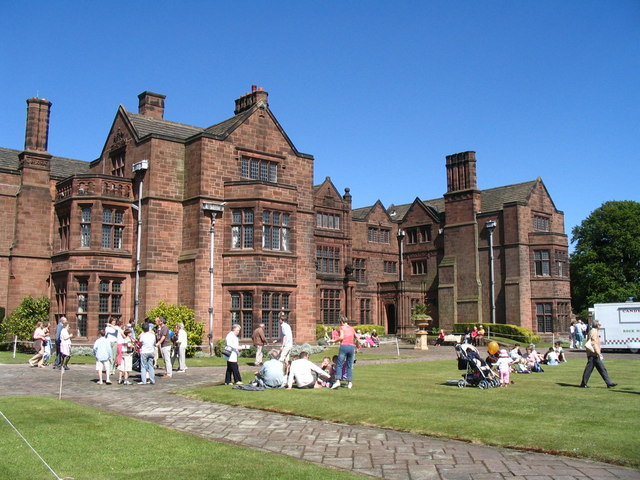

The story of Thornton Manor begins not with grandeur, but with a solicitor's modest investment. In 1849, Charles William Potts purchased the land and built a relatively unassuming country house. Fourteen years later, in 1863, he sold the property to Thomas Brittain Forwood, a Liverpool businessman who laid out the first parkland paths, a summer house, and a bridge across the grounds. Forwood died in 1884, and his son — Sir William Forwood, chairman of the Liverpool Overhead Railway — found himself with a house and no particular desire to live in it. In 1888, he let it to a tenant whose name would come to define the estate, the village, and much of the Wirral itself: William Hesketh Lever.
Lever was then in the thick of building his soap empire. His factory and model village at Port Sunlight sat just a few miles south, and he needed a family home within reach. Thornton Manor was convenient, handsome, and full of potential. By 1891, Lever had purchased the property outright, and the transformation began.
What Lever created at Thornton Manor was not simply a house but a statement of belief — that beauty, industry, and community were inseparable. He commissioned a relay of the finest architects of the age. Douglas and Fordham gave the house its Elizabethan character in 1896. J. J. Talbot added the stables in 1899 and a music room in 1902, its interior executed by the celebrated craftsmen H. H. Martyn & Co. In 1906, the main entrance was shifted from the west to the south with a grand new porch. Then, in 1913, J. Lomax-Simpson undertook the most ambitious reconstruction of all — adding the great western wings that gave Thornton Manor its definitive silhouette, sweeping and symmetrical against the Wirral sky.


But Lever's vision extended far beyond stone and slate. The grounds — some forty-nine hectares — were entrusted to Thomas Hayton Mawson, one of the most influential landscape designers of the Edwardian age. Mawson arrived in 1905 and set about creating a masterwork. Formal terraces were divided into geometrical beds by wide paved walks. Avenues of lime trees radiated outward. A sunken circular rose garden was scooped from the earth. A columned pergola known as "The Forum" gave the gardens an almost Mediterranean grandeur. Beyond the formality lay the wilder parkland: a lake with a boathouse and islands, ornamental pools, a canal aligned with the axis of the house, and dense woodland that muffled the outside world entirely. Mawson featured Thornton Manor in his landmark 1912 publication, The Art and Craft of Garden Making — a measure of how seriously both men took the project.


Between 1912 and 1914, Lomax-Simpson laid out a tree-lined avenue system spanning five miles through the surrounding countryside, connecting the estate to the wider landscape like the spokes of a wheel. The half-timbered gatehouse, designed by the same architect in 1910, still stands guard at the entrance — its black-and-white timber frame above a sandstone base as photogenic now as it was a century ago. The First World War brought Lever's building programme to a halt, and he left Thornton Manor in 1919, though he retained ownership until his death in May 1925.


Three generations of Leverhulmes called Thornton Manor home. William, the 2nd Viscount, inherited in 1925 and lived there until his death in 1949. Philip, the 3rd Viscount, carried the family presence through the second half of the twentieth century, dying in July 2000, just four days after his eighty-fifth birthday. With his passing, a continuous occupation stretching back to 1888 came quietly to an end. The following year, the house contents were auctioned in a sale that broke the United Kingdom record, raising ten million pounds — a final testament to the extraordinary collection the Leverhulmes had assembled within those walls.
In 2005, new custodians began a comprehensive restoration programme, and for the first time in its history, Thornton Manor opened its doors to the public. The estate now operates as a venue for weddings, events, and celebrations — its music room, formal gardens, and lakeside grounds finding new life in a new century. The manor even brushed against the highest levels of statecraft in October 2019, when Prime Minister Boris Johnson and Irish Taoiseach Leo Varadkar chose its grounds as the setting for pivotal Brexit negotiations. A serious fire in February 2022, requiring eight fire engines to bring under control, tested the building's resilience once more — but the estate endured, as it has endured every chapter before.
Thornton Manor preserves something more than architecture. It holds the material memory of a particular kind of Victorian idealism — the conviction that wealth, properly directed, could reshape an entire landscape for the better. The formal gardens, the model cottages of Thornton Hough, the five-mile avenue system reaching into the countryside: all of it was one man's attempt to make the world more beautiful than he found it. That the estate survives, Grade II* listed and open to visitors, is a tribute both to Lever's original ambition and to those who have cared for it since.
This article was partly inspired by old photographs and home recordings that came to light when someone brought their personal memories to be digitised. It made us wonder what else is out there — in attics, shoeboxes, old cupboards — connected to Thornton Manor and the community that grew up around it. If anyone holds old media connected to this estate, services like EachMoment can help preserve them for future generations.