
Heckington Windmill
HeritageHeckington Windmill: The Eight-Sailed Wonder of the Lincolnshire Fens
Stand upon the expansive, perfectly flat plains of the Lincolnshire Fens, and your eye is drawn inexorably to the horizon. There, slicing through the vast, dramatic skies of the East Midlands, is a silhouette quite unlike any other in Britain. This is Heckington Windmill, a towering titan of black-tarred brick, massive oak timber, and white canvas that has watched over the village of Heckington for nearly two centuries. To approach the mill on a breezy fenland day is to step back into a world powered entirely by nature’s breath. The rhythmic, heavy whoosh of its colossal sails cutting through the air, the deep, resonant creak of ancient internal timbers taking the strain, and the sweet, earthy scent of freshly ground grain combine to create a deeply immersive historical experience. It is not merely a static monument to a bygone agricultural era; it is a living, breathing mechanical giant, and famously, the only functioning eight-sailed windmill remaining anywhere in the world.
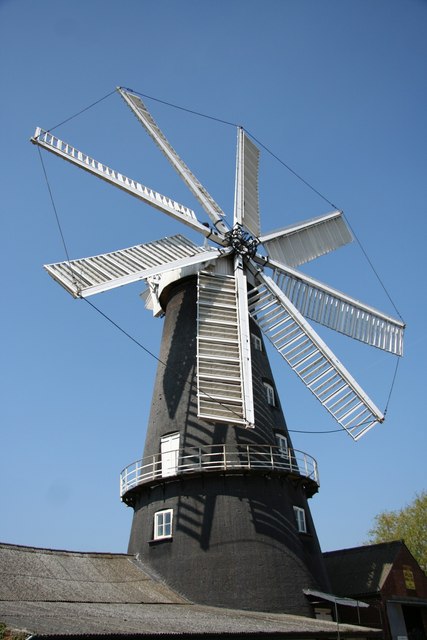
Photo: See Wikimedia Commons, See file page. Source
The story of this remarkable structure begins in the early nineteenth century, an era when the rural landscape of Lincolnshire was heavily punctuated by hundreds of windmills, each built to grind the county's staggeringly abundant cereal crops. Heckington Windmill was constructed in 1830 for Edward Pocklington, an ambitious local businessman and visionary who sought to harness the persistent, unimpeded fenland winds to build a milling empire. Constructed by renowned millwrights, the sturdy tower originally stood proud with a cap and five sails—a relatively common and highly effective configuration for the time, designed to provide steady, reliable power even in lighter breezes. Pocklington invested heavily in his new enterprise, constructing not just the windmill itself but an accompanying, self-sustaining complex that included a large bakehouse, stables, and outbuildings. He intended to control the entire process, from grinding the local wheat to baking and selling the bread. However, the capricious nature of commerce proved as unpredictable as the wind itself. Following a period of financial hardship, ruin followed, and the grand mill passed through various hands as the Victorian century wore on.
1830
Construction Begins — Built as a traditional five-sailed tower mill by the ambitious Edward Pocklington.
1890
The Great Tempest — A ferocious thunderstorm severely damages the tower, violently tearing away its original cap and all five sails.
1892
A New Crown — Master baker John Pocklington resurrects the mill, installing the magnificent eight sails salvaged from Tuxford's Mill in Boston.
1946
The Sails Stop Turning — The mill ceases commercial wind-powered operation as post-war industrial methods dominate and the great structure decays.
1953
Saved from the Brink — Kesteven County Council purchases the crumbling tower, heroically preventing its imminent demolition.
1986
A Triumphant Return — Following years of intensive restoration by devoted volunteers, the Heckington Windmill Trust proudly opens the site to the public.
2018
Full Restoration Complete — A multi-million-pound heritage project sees the mill fully restored with newly crafted sails, milling flour by wind once again.
The defining chapter of Heckington Windmill's existence—the catalytic event that would ultimately transform it from a typical, workaday fenland mill into a unique global icon—was born entirely out of disaster. In the height of summer in 1890, a ferociously violent thunderstorm swept unimpeded across the Lincolnshire flatlands. The tempest battered the tall brick tower with terrifying force, eventually tearing away the heavy timber cap and completely destroying the original five sails in a tangle of splintered wood and shredded canvas. For a time, it seemed the mill's working life was definitively over, destined to become just another ruined, ivy-clad stump dotting the rural landscape.

Photo: Ashley Dace , CC BY-SA 2.0. Source
Yet, salvation arrived in 1892 in the form of a man named John Pocklington. Remarkably, he was of absolutely no relation to the original builder, Edward Pocklington, but he shared the exact same unyielding entrepreneurial spirit. John Pocklington was an immensely successful master baker, miller, and businessman who saw the ruined tower not as a lost cause, but as an unparalleled opportunity. By a stroke of historical serendipity, at the very same time Heckington lay in ruins, another notable Lincolnshire landmark, Tuxford's Mill in the nearby port town of Boston, was being dismantled to make way for urban expansion. Tuxford's was an incredibly unusual eight-sailed mill, built to drive complex machinery. Pocklington, possessing a keen eye for engineering and a bargain, purchased its massive cap, the heavy iron windshaft, and all eight sails. In an extraordinary feat of Victorian heavy lifting, logistics, and ingenuity, the gargantuan components were transported across the county by horse and cart, and hoisted atop the Heckington tower. The marriage of the sturdy 1830 brick tower and the eight sails from Tuxford's created the magnificent hybrid we see today.
For decades, John Pocklington ran a thriving business. The eight sails provided immense, smooth power, allowing the mill to drive four pairs of heavy millstones simultaneously, grinding exceptional quantities of fine flour and coarse animal feed for the surrounding agricultural community. But the twentieth century brought the relentless, unforgiving march of industrial roller mills and the convenience of electrical power. Traditional milling became economically unviable. By 1946, the majestic sails finally ceased turning. Without the heat of constant friction and daily maintenance, the ravages of time, damp, and weather began to take their devastating toll on the great timber structure.

Photo: jpennycook, CC BY-SA 2.0. Source
What Heckington Windmill preserves today is not just an architectural shell, but the intricate, mechanical genius of the Industrial Revolution's agricultural sector. Stepping inside the cool, tarred brick tower, visitors find themselves surrounded by a labyrinth of massive oak gears, wooden cogs, and the great spur wheel, all operating with astonishing, rhythmic precision. The meshing of the apple-wood cogs against cast-iron pinions is a masterclass in pre-electric engineering. The site also carefully preserves the wider context of a busy Victorian milling complex. The old bakehouse, complete with its traditional brick ovens, has been meticulously restored, allowing modern visitors to taste bread and cakes made from the very flour ground by the wind high above their heads. The historic piggeries, the brewery, and the miller's house complete a remarkably intact, atmospheric vignette of nineteenth-century rural industry.
The survival and preservation of this site is a profound testament to dedicated conservationists and local pride. In 1953, with demolition looming as the tower became dangerously derelict, Kesteven County Council stepped in to purchase the crumbling structure, ensuring its basic survival. However, it was the formation of the Heckington Windmill Trust in the 1980s that truly breathed life back into the old giant. Driven by deeply passionate volunteers, the Trust tirelessly fundraised, scraped, painted, and laboured to return the mill to working order, officially reopening it to a jubilant public in 1986. More recently, a major, multi-million-pound regeneration project saw the complete restoration of the sails and the site's outbuildings, securing the mill's structural and educational future for generations to come.

Photo: shirokazan, CC BY 2.0. Source
The historical significance of Heckington Windmill extends far beyond the borders of Lincolnshire. As the sole surviving eight-sailed working windmill on earth, it represents the absolute zenith of traditional wind-milling technology. The addition of extra sails was a specific nineteenth-century innovation designed to capture more wind energy in variable conditions and provide a smoother, more continuous power delivery to the grinding stones below. To stand at the base of the tower and watch the massive, hypnotic eight-pointed star sweeping gracefully through the sky is to witness the ultimate evolution of a technology that sustained human civilisation for millennia, right before the dawn of the steam and electric ages eclipsed it entirely.
Today, Heckington Windmill stands not merely as a museum piece, but as a vibrant, active hub that connects modern generations directly with the ingenuity and hard labour of their ancestors. It continues to produce high-quality stone-ground flour, the sails turning with the exact same quiet, undeniable majesty they have possessed for over a century. The site looks forward to a bright future, continually expanding its visitor experience, baking workshops, and educational outreach. Uncovering and sharing the history of such magnificent places often relies heavily on the fragile fragments of the past left behind by those who lived and worked within their shadows. Indeed, this article was partly inspired by old photographs and recordings that came to light when someone brought their personal memories to be digitised. It made us wonder what else is out there — in attics, shoeboxes, old cupboards — connected to Heckington Windmill. If anyone holds old media connected to this organisation, services like EachMoment can help preserve them for future generations. The story of Heckington Windmill is far from over, carried ever onward by the relentless, eternal Lincolnshire wind.